
How to Track GRE Progress Using Only Practice Tests
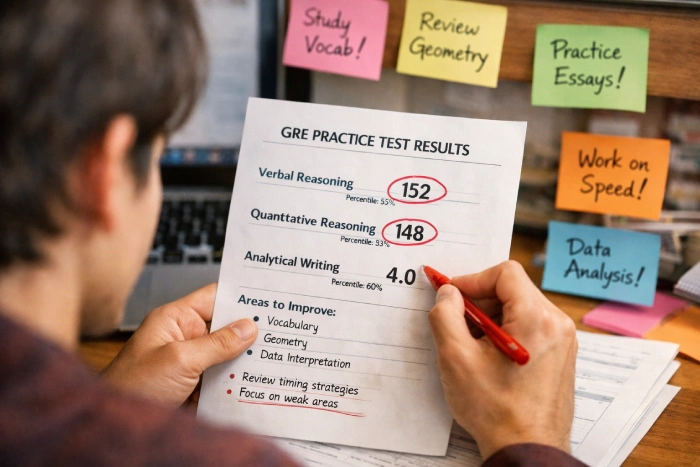
Studying for the GRE is not a guessing game. You need to have a clear way to see if your marks are improving or not. Learning how to evaluate GRE performance using mock tests is one of the smartest ways to start your preparation. You need to learn how to use your practice materials, practice tests, and how to identify your strengths and weaknesses.
To have a good GRE practice test score analysis strategy, you need to look beyond the final score. In this guide, we will show you how to treat every practice test as a diagnostic tool and how to improve your scores.
Setting the Baseline: Your Initial Diagnostic Test
It is impossible for you to track your progress if you have no idea where you started from. Before you even learn from different notes and lectures, you need to take a full-length practice test under realistic testing conditions. This first practice test will give you a baseline score and an idea about your current skills and knowledge.
There are a lot of students who ask, how accurate are GRE practice test scores? When we take them right at the beginning. These tests are very accurate if you don’t pause the timer in between and complete the full exam.
Simple Guide to Starting Your Baseline Test
Replicate the test center: You need to create the same environment as the test center, such as sitting in a quiet room, having a timer, and no distractions or taking breaks in between.
Respect the clock: Use the same timings as the exam and don’t take extra time to finish the questions.
Ignore the initial stress: ignore the initial score and don’t stress over it, as this is just to get the idea of your weaknesses and strengths, and you will actually start studying after this test.
| Testing Factor | Correct Practice Setting | Incorrect Practice Setting |
| Time Limits | Follow the official countdown clock strictly. | Pause the exam to finish thinking through a question. |
| Tools Used | Only use the official on-screen calculator. | Use a physical calculator or your smartphone. |
| Environment | Study in a quiet, distraction-free space. | Take the exam on your bed with music playing. |
When you get your initial score, you need to start studying by using GRE Practice Questions, as they can help you to prepare for the kind of questions that appear in the exam.
Building Your Blueprint: Data-Driven Study Plans
Create an organized schedule based on your baseline score. You can avoid wasting time on subjects you already understand by using a GRE study plan based on practice test results.
Every week, concentrate more on charts, graphs, and statistics if your quantitative score is poor because of data interpretation issues.
Spreading out your practice exams across your schedule is the best way to use GRE practice tests effectively. Burnout might result from taking tests every day. Additionally, there isn’t much time in between tries to learn from mistakes.
Simple Steps for Structuring Your Routine
| Week | Target Action | Purpose |
| Weeks 1–3 | Core Skill Building | Focus heavily on the concept areas you missed on your first mock test. |
| Week 4 | Mid-Point Check | Take a second practice test to measure your progress. |
| Weeks 5–7 | Advanced Strategy | Improve pacing and practice difficult multi-step problems. |
| Week 8 | Final Simulation | Take a final mock test to strengthen your pacing strategy before test day. |
Identifying and Filtering Section-Specific Adaptation
The exam’s adaptability is a big surprise for a lot of students. Your performance in the first segment is used by the computer to modify your performance in the second.
Paying attention to this change is necessary to comprehend how to evaluate GRE performance using mock tests. It displays if you initiated a more difficult, higher-scoring second section.
The test may be adjusted downward if you make a lot of careless errors in your initial verbal or quantitative portion. This may result in a second section that is simpler and has a lower maximum score.
Simple Adaptation Matrix
| Exam Section | Good Diagnostic Result | Bad Diagnostic Result |
| Section 1 (Mix) | High accuracy on easy and medium questions triggers a tougher second section. | Sloppy errors on basic concepts drop you into a lower-tier section. |
| Section 2 (Adaptive) | Maintaining a stable score here proves your advanced skills are solid. | Feeling that the questions got much easier is a sign that you missed too many early problems. |
The Error Log: Tracking Mistakes Step-by-Step
A final score indicates your position, but an error log explains why. Spend more time reviewing your test than taking it if you want to get better. Sort each incorrect response according to concept, question type, and the cause of the error. Distinguish between casual errors and conceptual errors. Focus, not knowledge, is the problem if you understand the procedure but make a reading or math error. This breakdown makes it easier to focus on your weak points and keeps you from making the same errors on subsequent exams.
Error Tracking Checklist
Keep track of all the questions you missed or got wrong.
Identify the pattern of your mistakes, such as was it lack of time, and a vocabulary gap that led to wrong answers.
Try to solve the wrong questions after the exam before you look at the solution.
If you often struggle to find shortcuts for these questions on your own, GRE exam tutoring services
can help you overcome score limits.
Pacing and Mental Stamina: Tracking Time Data
Time management is crucial for your score because the shorter GRE format necessitates quick thinking in between questions. Examine how much time you spent on each question as you go over the practice exams. You will probably lose points later in the section if you took more than three minutes to complete a single quantitative comparison task.
Students often ask, how accurate are GRE practice test scores if they run out of time on the final section? Because pacing is a component of the test design, the scores remain correct. Completing a section is just as detrimental to your score as incorrect responses.
Simple Pacing Guides
| Metric | Ideal Strategy | Dangerous Strategy |
| Per-Question Time | Spend roughly 1.5 minutes on math and 1 minute on verbal questions. | Spend 4 minutes trying to force a solution on a single hard problem. |
| Skipping Strategy | Guess, flag the question, and move on if you are completely stuck after 45 seconds. | Leave questions completely blank, hoping to return to them later. |
| Final Review | Save 2 minutes at the end of a section to check your flagged answers. | Sprint through the final three questions with seconds remaining on the clock. |
Frequently Asked Questions
Can I track GRE progress without using analytics tools or coaching?
Yes. You can track your GRE progress without any tools. You can use a basic Excel sheet or a notebook to write down your errors and how you improved them. The only thing you need to focus on is being honest about your mistakes and why they happened.
How many practice tests should I take to measure progress?
There is no limit to taking practice tests, but the ideal number is 3 to 5 full-length tests over the whole 8-week study period. This gives you enough data to track your progress while leaving other days for study.
What if my scores fluctuate between practice tests?
Minor score changes are normal, such as 3 to 4 points. So instead of looking at single test scores, you should look at your improvements from the first test to the last one.
Is timing important for tracking GRE improvement?
Yes, timing is the most important. You have to keep a strict track of your time and should have some time management strategies to complete the exam on time. When you know your speed of answering, you can work on it before the final exam.
Conclusion: Let the Data Guide Your Prep
Instead of only preparing from notes, students need to use practice tests to study for the GRE exam. Practice tests give actionable steps, help you to improve your weak areas, and gives your confidence. As you keep improving your mistakes one by one, you will slowly start getting better marks. However, this process will take patience and a study schedule. If you need help with pacing strategies or want someone to help you with your weak areas, you can get professional help from a tutoring service.