
Average GRE Scores for Top Universities
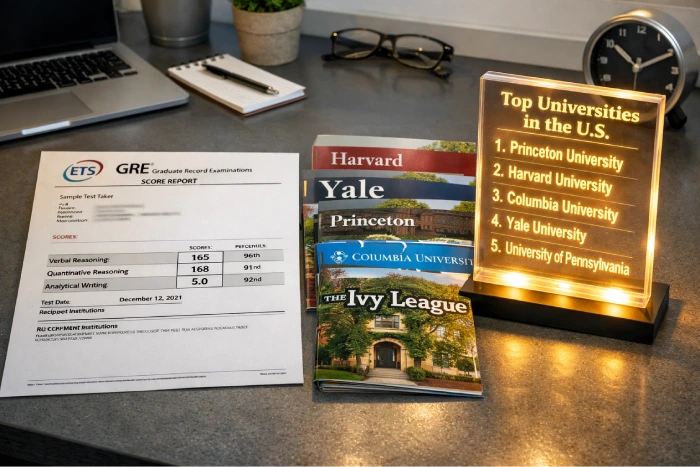
Many graduate applicants worry that they need almost a perfect average GRE scores for top universities. The truth is more encouraging. While a good score can improve your application, there is no universal GRE score that guarantees admission. Every university and even every department sets its own requirements.
If you are searching for good GRE score for top universities, this guide provides realistic benchmark ranges rather than official cutoffs. We will explore common score expectations by university tier and program type, explain how test-optional policies are changing admission criteria, and provide practical strategies for improving your score. If you’re preparing for your exam, the GRE Exam Help Service homepage offers study resources and expert guidance to help you reach your target.
Is There an Official GRE Cutoff for Top Universities?
There is no universal GRE cutoff top universities. The Educational Testing Service (ETS), which administers the GRE, does not establish official GRE scores or admission cutoffs. Instead, graduate departments decide whether to require the GRE and how much weight to give it during admissions. This means two master’s programs at the same university may have completely different expectations. One department may strongly recommend GRE scores, while another may be entirely test-optional or test-blind.
Many prestigious colleges have lessened their dependence on standardized testing in recent years. Test-optional or test-blind policies have been implemented by several departments at universities including Harvard, MIT, and Stanford, while program requirements differ. Instead of thinking the institution has a single policy for each graduate program, always check the admissions website or look for How Universities Are Using GRE Scores Differently in 2025 if you wish to apply.
Average GRE Scores by University Tier
The ranges shown below are not official admission criteria; rather, they are often used benchmarks for GRE university admission.
| University Tier | Typical Competitive GRE Benchmark |
| Highly selective universities | 320+ overall |
| Strong research universities | 310-320 |
| Flagship public universities | 305-315 |
| Regional graduate programs | Vary depending on the program |
A score of more than 320 is often advantageous for applicants aiming to attend prestigious research universities, particularly in subjects that are very competitive. Since each graduate school has its unique admissions requirements, many students looking up the GRE score for Harvard Stanford MIT discover that there isn’t a single necessary score.
The GRE score requirements Ivy League colleges also differ by program; some departments mandate the test, some make it voluntary, and still others have test-blind practices. However, many successful applicants are admitted with lower scores since admissions committees also consider leadership, research experience, academic achievement, and professional accomplishments. Humanities programs may promote verbal reasoning, whereas STEM programs frequently place more emphasis on quantitative reasoning. Instead of concentrating solely on the reputation of the university, wherever you can, compare your scores with the expectations of your chosen department.
Average GRE Scores by Program Type
Different graduate programs value different parts of the GRE. The average GRE score by program type are as follows:
| Program Type | Common Competitive Benchmark |
| STEM, Engineering & Computer Science | Quant typically 163–168 |
| Business & Management | Balanced Verbal and Quant in the low-to-mid 160s |
| Social Sciences | Strong Verbal, usually 160+, with solid Analytical Writing |
| Humanities | High Verbal scores and strong writing performance are often most important |
STEM & Engineering
Quant scores are typically quite competitive for students applying to schools in engineering, mathematics, computer science, and data science. Although expectations vary by school, many successful candidates score between 163 and 168 on Quantitative Reasoning.
Business Programs
The GRE is accepted as a substitute for the GMAT in many MBA and specialty business master’s programs. The GRE score for top business schools is usually score in the low-to-mid 160s, exhibiting balanced performance in both the verbal and quantitative parts.
Humanities & Social Sciences
Verbal reasoning and analytical writing are typically given more weight in programs like English, history, political science, psychology, and sociology. Your application may be strengthened if these areas demonstrate your strong communication abilities.
Also, if you are pursuing an MS in USA, research your department carefully to find the GRE score for MSin USA and work accordingly.
How Much Do GRE Scores Really Matter in 2026 Admissions?
Although they are still important, GRE scores are just one component of a comprehensive admissions process.
Students usually ask what GRE score do I need for grad school, so committees for graduate admissions usually assess:
- GPA for undergraduates
- Transcripts of academic work
- Experience with research
- A statement of intent
- Letters of recommendation
- Experience working or interning
- GRE results (if necessary)
An average application might be strengthened by a good GRE score. For instance, candidates with somewhat lower GPAs may show that they are prepared academically by performing well on standardized tests. However, a poor recommendation or a weak statement of intent cannot be made up for by an outstanding GRE score alone.
Before arranging the test, candidates should carefully check the current admission standards because more colleges have implemented test-optional policies.
How to Find Your Target Program’s Actual GRE Expectations?
The graduate department itself is always the finest source of information.
When looking at programs:
- Go to the admissions website of the department.
- Verify if GRE results are necessary, optional, or not taken into account.
- Look for public class biographies that display the average scores of accepted students.
- For the most up-to-date information about admissions, see the FAQs.
Remember that entrance requirements are not always met by average scores. They only offer a useful reference point for organizing your preparation.
How to Reach a Competitive GRE Score?
Understanding your present performance is the first step in achieving a competitive GRE score. Before making a study plan, take a full-length practice test to get an honest baseline. This will assist you in determining your target program’s strengths and flaws as well as the necessary score improvement. You may begin by taking an online GRE practice test.
After you’ve determined your baseline, create a study strategy that concentrates more on your areas of weakness. Spend more time on Quantitative Reasoning if you’re applying to engineering or STEM majors. Balance your preparation by honing your analytical writing and verbal reasoning skills if you’re aiming for business, social science, or humanities schools. To track your progress, go over your mistakes on a regular basis and take timed practice tests. For additional guidance, students can explore GRE Score Improvement Strategies That Really Work.
Consider engaging with a professional instructor if self-study isn’t assisting you in achieving your desired score prior to application deadlines. Get GRE Preparation Tips to Score 320 on First Attempt by tailored study programs, professional criticism, and focused practice.
Frequently Asked Questions
Q: What GRE score do I need for a top university?
There’s no official cutoff — competitive applicants at highly selective universities commonly post composite scores of roughly 320 or higher, but requirements vary significantly by specific program and department.
Q: Do all top universities require the GRE?
No, an increasing number of top programs, including some departments at MIT, Harvard, and Stanford, have gone test-optional or test-blind, so requirements now vary even within the same university.
Q: Is GRE Quant or Verbal more important for top programs?
It depends on the field — STEM and engineering programs typically weight Quant more heavily, while humanities and social science programs often place more emphasis on Verbal and Analytical Writing.
Q: What is considered a good GRE score for business school?
For business programs that accept the GRE, balanced Verbal and Quant scores in the low-to-mid 160s are commonly competitive at top schools, though exact expectations vary by program.
Q: Can a strong GRE score make up for a lower GPA?
A strong GRE score can help balance a weaker GPA in a holistic review, but it’s one factor among several, including research experience, statement of purpose, and recommendation letters.
Conclusion:
Achieving admission to a top graduate program is about much more than earning the highest possible GRE score. In reality, there is no answer to a “good GRE score”. The average GRE scores for top universities vary by institution, department, and field of study. You may find more inspiration by reading these student success stories on our homepage.
If you have inquiries regarding your preparation or score objectives, check out the GRE Tutoring Service for individualized advice. Or Contact Us to get in touch with the experts.